The lights dim, your guests circle the dance floor with phones raised, and suddenly the spotlight is squarely on the two of you. It is one of the most intimate traditions of your reception, and for many couples, easily the most anxiety-inducing. The dread usually isn’t about executing a Broadway-level routine; it’s the horror of being trapped in a stiff, three-minute “middle-school sway” while wondering what to do with your hands. The good news? A memorable, romantic, and stress-free first dance doesn’t require a lifetime of ballroom experience. It just takes the right strategy.
Whether you want a fully customized routine or simply enough structure to look confident and natural, this comprehensive guide breaks down everything you need to know about wedding first dance choreography, music selection, lesson timelines, and the common pitfalls to avoid.
Table of Contents
Do You Really Need Wedding First Dance Choreography?
The short answer is no, you do not need an elaborate, viral-worthy routine. However, you do need a plan. “Choreography” in a wedding context rarely means strict, count-by-count routines like you see on television. For most couples, choreography simply means having a clear framework: a confident entrance, two or three foundational steps, a smooth spin, and a dip or finishing picture for the photographer.
Without that framework, three minutes feels like an eternity. Having even basic choreography eliminates decision fatigue on an already adrenaline-fueled day. It allows you to stop worrying about stepping on your partner’s toes and actually look at each other, breathe, and soak in the moment.
First Things First: The Song
Your music dictates everything from your pacing to your body language. Before you take a single step, you need to understand how your song choice will play out in real time on the dance floor.
Pick a Track That’s Truly Yours
Do not feel pressured to pick a slow ballad just because it is traditional. If you both bonded over 90s indie rock, classic Motown, or upbeat acoustic covers, lean into it. The most memorable first dances are authentic representations of the couple’s personality. If you do opt for a popular classic (such as Ed Sheeran, Frank Sinatra, or Etta James), consider finding an acoustic or live version that gives your moment a distinct personal identity.
Watch the Length and the Tempo
The single biggest mistake couples make is letting an entire 4-minute track run. On a dance floor, anything longer than two to two-and-a-half minutes begins to drag for both the dancers and the audience. Work with your DJ or band leader in advance to establish an exact fade-out point, or edit the audio file beforehand so you rehearse with the exact duration you will dance to on the night.
In terms of tempo, watch out for songs that are either deceptively slow or deceptively fast. A slow ballad requires tremendous balance, control, and poise, while a rapid track can leave you out of breath. Aim for a moderate tempo of around 80 to 100 beats per minute (BPM) if you want an effortless, relaxed rhythm.
An Idea Couples Love: The Switch Halfway Through
If you are torn between a heartfelt romantic moment and an energetic party starter, you can have both. Start with 60 to 90 seconds of a romantic slow song. Then, have your DJ cue a record-scratch effect or an abrupt, joyful beat drop into an upbeat track. You can either perform a fun, rehearsed 30-second sequence together or immediately wave your wedding party and guests onto the floor. It instantly shatters the formality and kicks off your reception party on a high note.
The Wardrobe Variable: Dresses, Bustles, and Slippery Shoes
You can master your routine in athletic clothes in your living room, but dance day happens in formalwear. Wedding dresses, especially ballgowns, mermaid silhouettes, and dresses with long trains, drastically change your center of gravity and foot clearance. A heavy bustle can pull backwards, and a tight skirt restricts backward steps.
To avoid day-of surprises, schedule at least one rehearsal wearing your actual wedding shoes (or shoes of equivalent heel height and sole grip). Men should practice wearing their suit jacket at least once, as tailored jackets restrict shoulder mobility during high turns and lifts. Furthermore, test the grip of leather soles: brand-new dress shoes on a polished wood or vinyl dance floor can be extremely slick. A simple strip of non-slip adhesive tape or scuffing the soles with sandpaper can prevent an unexpected fall.
The Room: Floor, Space and Surface
A wedding dance floor is often small, sometimes carpeted, sometimes outdoors on grass or decking. Spins on grass do not work, and anything that needs a slide does not work on carpet. Before we design a routine we ask for a photo or a video of the space, and we adapt the choreography if the venue moves the dance floor.
Simple First Dance Choreography: An Easy Structure Any Couple Can Learn
Most couples who search for an easy first dance want the same thing: something that looks planned without months of lessons. The answer is not more steps. It is fewer steps, placed with intent, plus a “home base” move you can always fall back on.
This is the structure we use as a starting point for couples with no dance background. It fits a song of about three minutes and can be learned in three or four sessions.
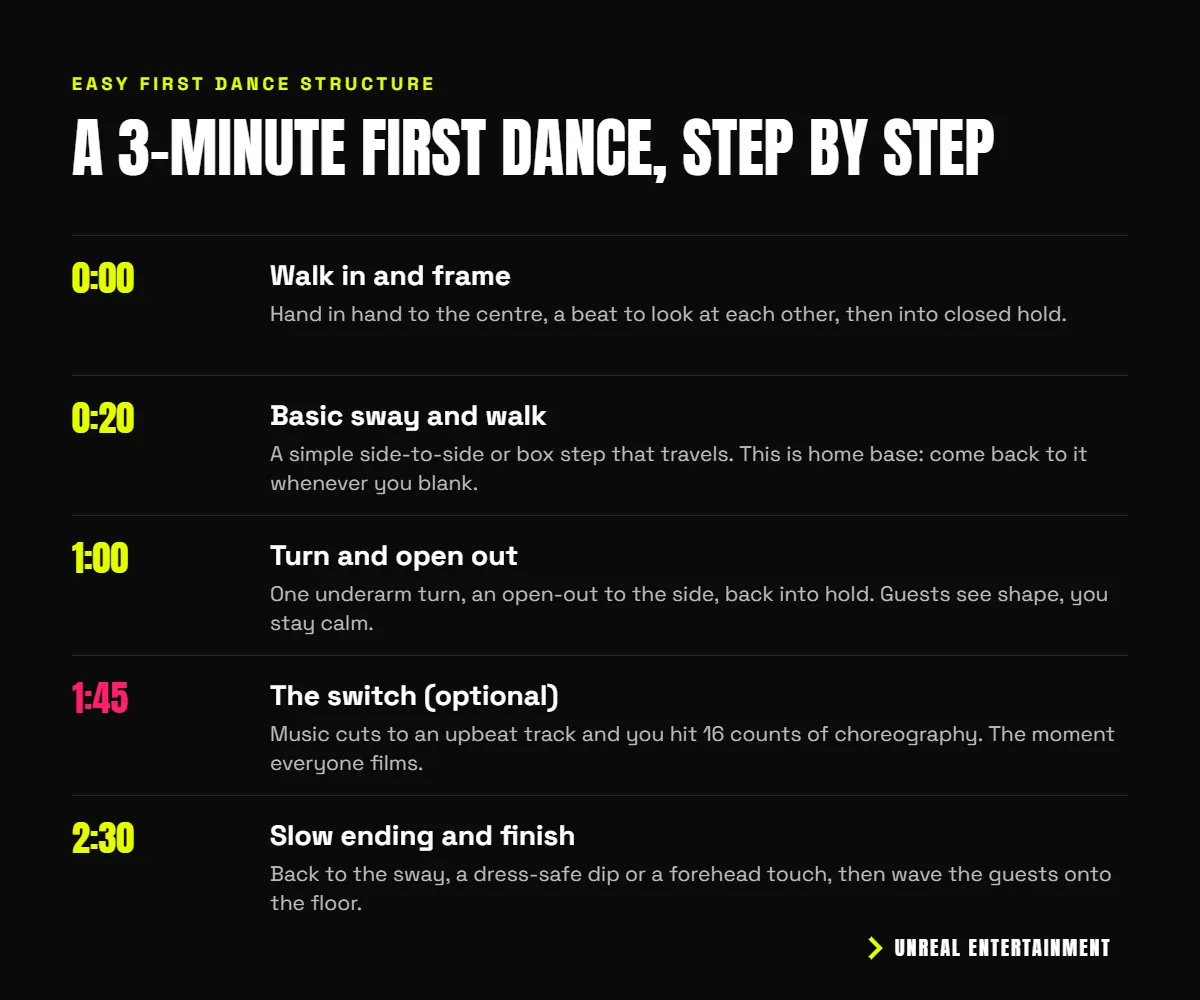
- Entrance (0:00 to 0:20). Walk in together, stop in the centre, take a breath and look at each other before you go into hold. Those few seconds are exactly what the photographer is waiting for.
- Home base (0:20 to 1:00). A side-to-side sway or a box step that slowly travels around the floor. If either of you blanks later, you come back here and nobody notices.
- One turn, one open-out (1:00 to 1:45). An underarm turn and an open position to the side give the dance some shape for the guests watching from their tables.
- The switch, if you want it (1:45 to 2:30). The music cuts to something upbeat and you hit 16 to 32 counts of real choreography. Optional, but it is the part everyone ends up filming.
- The ending (2:30 to 3:00). Back to the slow track, a dip that works with the dress or a simple forehead touch, then wave your guests onto the floor.
Bride and groom first dance choreography does not have to be symmetrical, either. If one of you is more comfortable moving, give that person the turn and the switch and let the other hold the frame. It looks intentional, and it is far less stressful than both of you trying to learn the same thing.
How Many Lessons Do You Actually Need?
The number of lessons you book depends entirely on your comfort level and goals:
- 1 to 2 Lessons (The “Crash Course”): Perfect for couples who just want to avoid looking awkward. You will learn how to hold each other with proper posture, master a natural box step or side-to-side rotation, and execute a clean final dip.
- 3 to 5 Lessons (The “Comfortable & Polished” Tier): The sweet spot for most couples. This gives you time to build muscle memory, learn two to three smooth transitions or spins, match movements to musical accents, and practice your entrance and exit.
- 6 to 10+ Lessons (The “Full Showcase”): Recommended if you want a fully customized, start-to-finish routine with lifts, intricate footwork, or a surprise multi-song mashup.
The First Dance Mistakes Couples Make Most Often
Even couples who take lessons fall victim to a few common traps. Keep these on your radar:
- Looking down at your feet: When you are nervous, your eyes naturally drop to track your steps. This breaks your posture, ruins wedding photos, and disconnects you from your partner. Keep your chin parallel to the floor and look into your partner’s eyes (or at their shoulder).
- Starting the dance instantly: Many couples rush in as soon as the music starts. Take your time. Walk to the center of the floor, hold hands, smile at your guests, settle into frame, and let 8 to 16 beats of music pass before taking your first step.
- Not cueing the photographer and DJ: Tell your photographer where your routine finishes so they can position themselves for the dip, and ensure the sound engineer knows your exact finish cue so the music fades out naturally.
The Entrance, the First Four Seconds and the Ending
Three moments outside the routine decide how the whole dance reads. The entrance: walk to the floor together, instead of drifting in one at a time while the DJ waits. The first four seconds: decide exactly where you stand, where you look and what happens on the first beat; if those seconds are certain, the nerves drop and the rest follows. The ending: a defined final position held for two counts, so the song does not end with you wondering whether to bow. A hold and a kiss is easy to remember and photographs well.
The Surprise Routine: Is It Worth It?
The switch from a slow song into something upbeat, with the wedding party joining in, still works, and it works because of the switch more than the steps. It costs at least one extra rehearsal with everyone involved, and the routine has to be simple enough for the least confident person in it. If you want the effect without coordinating the whole family, professional dancers can take over the second part: you dance your moment, then the energy jumps and nobody else has to rehearse.
DIY vs. Hiring a Wedding Dance Choreographer
If you are working on a tight budget, YouTube tutorials and self-guided practice can yield great results, provided you are disciplined and start at least three months in advance. The DIY approach works best if you keep the routine minimal and focus purely on rhythm and timing.
However, working with a wedding dance specialist provides personalized adjustments based on your dress silhouette, song structure, and dance floor dimensions. A professional instructor also serves as an objective mediator: practicing dance with your fiancé can occasionally bring out wedding stress, and a professional keeps the atmosphere fun, lighthearted, and constructive.
A choreographer is also useful for deciding what not to do. Much of the work with couples is subtraction: cutting the move that does not fit, shortening the song, dropping the lift you saw online.
A Simple 4-Step Action Plan That Works
- 3–4 Months Out: Finalize your song and make an initial 2-minute audio cut. Decide between DIY learning or booking a dance studio.
- 2 Months Out: Begin lessons or home practice sessions (15–20 minutes, three times a week). Focus on rhythm and basic movement first before attempting spins.
- 3 Weeks Out: Practice with your actual wedding shoes and a skirt or jacket similar in cut to your wedding attire.
- Week of the Wedding: Do one or two relaxed run-throughs at regular speed. Resist the urge to over-analyze every step; focus on eye contact and connection.
Frequently Asked Questions
How long should a first dance be?
Around two to two and a half minutes. Cut the track rather than dancing a full-length song.
When should we start taking wedding dance lessons?
The optimal window is 8 to 12 weeks before your wedding date. Starting earlier risks forgetting the steps, while waiting until the final month adds unnecessary stress to an already packed schedule.
What if one of us has two left feet?
A good instructor designs choreography around your natural strengths. You don’t need complicated footwork; simple, confident movements executed with good posture and a smile look far better on camera than complex steps performed with visible panic.
Can we do a dip if the dress has a corset or heavy train?
Yes, but opt for a supported “side dip” or an “architectural lean” rather than a dramatic backward drop. A professional instructor can show the lead how to properly brace the follower’s back and weight so the dress stays secure and both dancers remain stable.
What is the easiest first dance choreography?
A sway or box step as your base, one underarm turn and a simple ending. Three moves, done with confidence, are enough for a song of about three minutes.
How much does first dance choreography cost?
It depends on how many lessons you need and whether the routine is built from scratch or adapted to your song. We explain how pricing works in our guide to what a dancer costs for an event.
Talk to Us About Your First Dance
We build every first dance around the couple, the song and the room, working with couples around Varese, Milan and the rest of Lombardy. Tell us your date and venue and we will tell you honestly how much work it needs. See our first dance choreography for weddings and how we train and coach.